Real estate funds and syndications
Investor reporting
What to put in a quarterly investor report
A good quarterly report lets an investor answer three questions without calling you: how are the properties doing, what did I get, and what happens next. Here is what goes in one, with a sample you can open.
In short: lead with NOI by property against budget, then cash and debt, then the quarter’s distribution and each investor’s capital account, and close with a few plain sentences on what moved and what’s next. Every number should come from closed, reconciled books.
The five parts
1. How the properties did
NOI for each property against budget, for the quarter and year to date. Operating income tells investors more than net income, because depreciation and interest can push a property’s net income below zero even in a good year.
2. Cash and debt
Cash at the fund and at each property, loan balances, and anything a lender is watching.
3. Distributions
What was paid this quarter, and what investors have received since the deal began.
4. Partners’ capital
Each investor’s capital account: contributions, their share of income, distributions, and the balance at quarter-end. This is the same figure that ends up on their K-1, so it should tie to the books every quarter.
5. What moved, and what’s next
A short note in plain words. Which property is behind budget and why, what’s happening with leasing or a refinance, and when the next distribution is expected.
See a sample
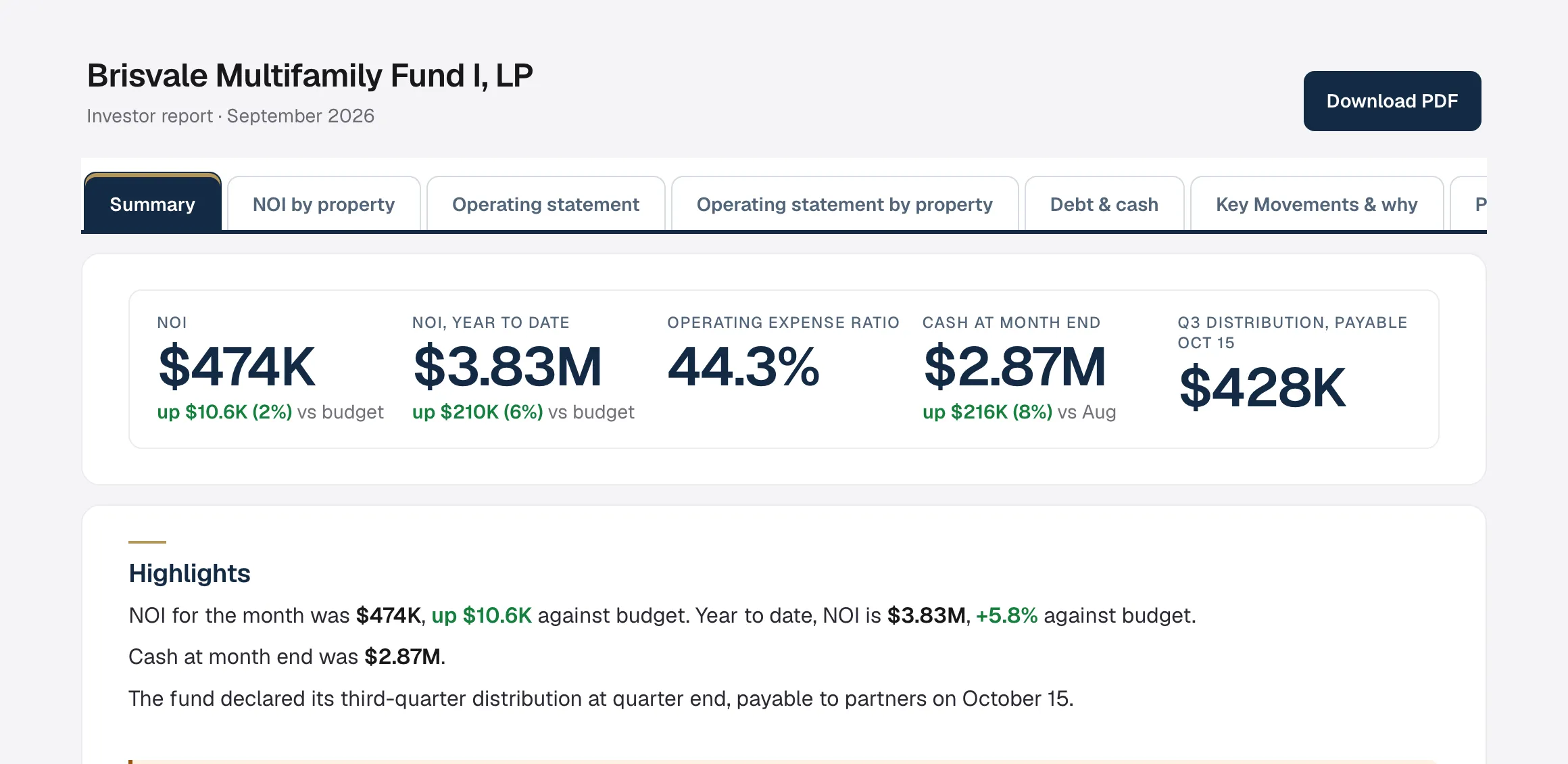
The sample shows NOI by property against budget, cash, the quarter’s distribution and partners’ capital, with a PDF version for investors who want a file.
Mistakes that cost investor trust
- Numbers that don’t tie. A distribution in the report that doesn’t match the capital account, or the K-1, raises questions for months.
- A report rebuilt by hand each quarter. Copying figures into Excel is where errors get in, and it’s why reports arrive late.
- Silence on bad news. A property behind budget, explained early, worries investors far less than a surprise.
How Outlane does it
We close every entity each month, run distributions through each deal’s waterfall and record them in capital accounts, then build the quarterly investor report from the closed books. Your investor portal is kept current and investor questions are answered. Every engagement is led by Deepika Bajaj, CPA, who cut a 65-entity real estate platform’s investor reporting cycle from 40 to 20 days.
Common questions
What should a quarterly investor report for a syndication include?
How each property performed against budget (usually NOI), cash and debt, what investors received this quarter and since the start, each investor’s capital account, and a short note on what changed and what happens next.
How often should a sponsor report to investors?
Quarterly is the common rhythm for syndications and real estate funds, with a notice each time a distribution is paid and the K-1 once a year.
Do you have a sample investor report?
Yes. Outlane’s sample investor report for a fictional apartment fund is at outlane.ai/sample/real-estate-fund, with a PDF version.
Who prepares the report?
Outlane prepares it from the closed books every quarter and keeps your investor portal current.